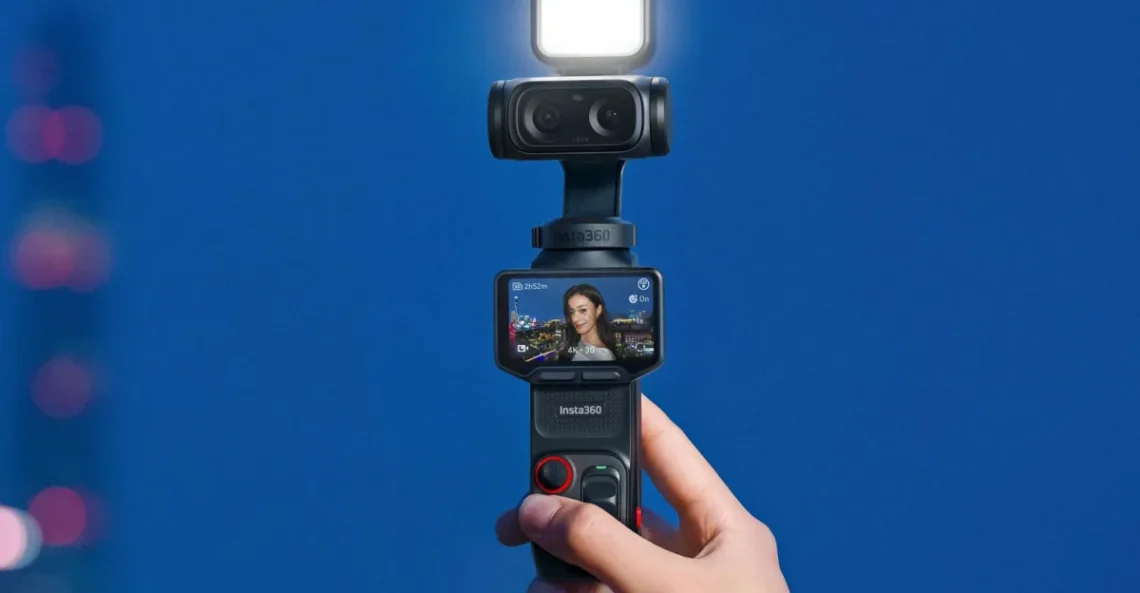
Insta360 opened U.S. sales today for the Luna Ultra, a dual-sensor handheld camera capable of recording 8K video while self-stabilizing on a three-axis gimbal.
The device is listed at $769.99 on the company’s online store as well as major retailers Amazon, B&H, and Best Buy. With DJI’s Pocket 4 and Pocket 4P still unavailable in the United States, Luna Ultra becomes the highest-resolution pocket gimbal now sold domestically, positioning Insta360 at the top of the niche consumer-creator segment. For additional market analysis, see our technology coverage.
Hardware leap: 8K capture in a pocket form factor
The Luna Ultra houses a pair of 1-inch 8K sensors and shoots through matched lenses mounted on a three-axis mechanical gimbal. That configuration allows independent horizon leveling and in-camera flow-state stabilization, features previously limited to larger rigs or 360-degree systems. A built-in touchscreen enables direct framing, while the detachable wireless remote doubles as a compact tripod handle—an approach designed for solo operators who routinely move between vlogging, B-roll, and live streaming.
“Insta360 announced global availability for the Luna Ultra on 2 June 2026,” summarizes the company’s product timeline. A parallel statement from the firm notes that the camera’s dual-sensor architecture targets filmmakers who need both ultra-wide coverage and instant reframing for vertical platforms.
Competitive context and market timing
DJI’s popular Pocket line tops out at 4K/120 fps capture; neither the Pocket 4 nor the Pocket 4P has secured U.S. distribution. By shipping an 8K option first, Insta360 fills a vacuum for creators seeking higher resolution without stepping up to larger mirrorless bodies or modular action cams. According to retail listings, Luna Ultra’s launch price undercuts the combined cost of a 4K camera body and dedicated gimbal by several hundred dollars, reinforcing its value-for-specifications proposition.
The category itself is growing. Research firm Futuresource Consulting reported that shipments of compact stabilized cameras rose by double digits in 2025 as independent content producers sought cinematic motion without crewed shoots. Luna Ultra enters this climate with the headline specification—8K—that signals future-proofing for platforms increasingly experimenting with high-resolution streaming.
From hints to hardware: a two-year buildup
Public anticipation began with controlled “teaser” clips in late 2024, followed by unauthorized image leaks that surfaced online in early 2025. Insta360 then staged a discreet demonstration during the NAB Show 2026 in Las Vegas, inviting select industry partners but withholding detailed specifications. After an initial retail rollout in China this spring, today’s release marks the first time the camera is officially offered worldwide.
One self-contained milestone underscores the narrative: “Insta360 introduced the Luna Ultra to U.S. consumers on 2 June 2026 at a launch price of $769.99.” The date caps a multistage go-to-market strategy that deliberately held back inventory until global logistics and language-localized firmware were in place.
Implications for creators and the wider ecosystem
The move broadens hardware options for travel vloggers, documentary shooters, and newsroom field reporters who must pack light yet deliver broadcast-grade footage. In practice, an 8K master file provides latitude for post-production cropping to 4K or 1080p deliverables without sacrificing sharpness—a workflow advantage when reframing for vertical, square, and horizontal outputs.
For Insta360, Luna Ultra extends the brand beyond its core 360-degree cameras into a segment long dominated by DJI. The company’s existing mobile editing suite now supports 8K timelines, which could drive additional subscription revenue. Meanwhile, U.S. retailers gain a marquee product able to offset the absence of DJI’s latest Pocket models, potentially reshaping shelf dynamics in the creator-tech aisle during the second half of 2026.
Institutional buyers are also watching. Educational media labs, corporate communications teams, and live-event producers often standardize on small-form cameras for safety rigs and behind-the-scenes coverage. Early access to 8K capture may accelerate upgrades across those fleets as budgets cycle into the new fiscal year.
Analysts will track whether Luna Ultra’s feature set triggers a domino effect among competitors or prompts DJI to expedite U.S. certification for its own 8K devices. Either outcome would validate consumer appetite for pocketable high-resolution stabilizers.
For now, creators looking for an all-in-one rig receive their first 8K option backed by a mainstream brand and a full U.S. warranty—an incremental but notable milestone in the democratization of professional-grade imaging.