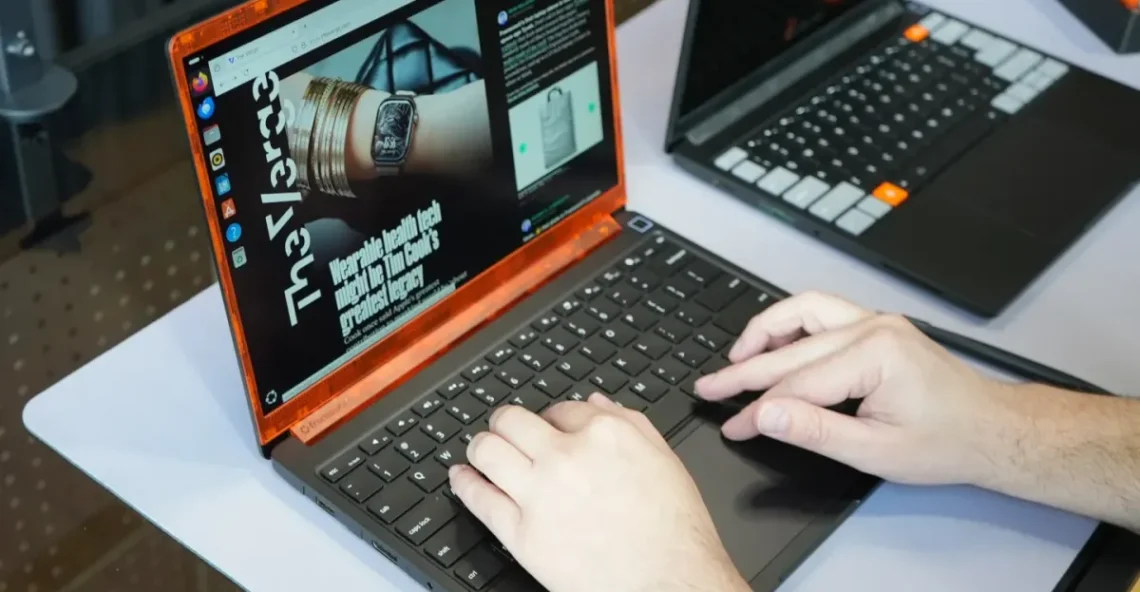
Framework Computer has notified customers that initial shipments of its 13-inch Laptop 13 Pro have slipped from June to July, with some orders now projected for August or early September.
The delay, shared in an email to buyers, underscores the manufacturing complexity involved in integrating a brand-new haptic trackpad and a custom display panel—two marquee features of the company’s latest modular notebook. As a result, only the very first production batch is still expected to leave the factory in July; all subsequent batches are moving back by roughly one month.
Framework, best known for laptops built around easily replaceable components, did not cite broader supply-chain disruptions. Instead, the company attributed the schedule change to final validation of the two bespoke parts. The message did not indicate issues with other configurations, but it confirmed that machines configured without the new trackpad or display are on a different production line and remain on their original timeline.
What the setback means for early adopters
According to Framework’s correspondence, customers in the first shipping wave could still see their units slip into the first week of August if additional tuning is required. Those in later waves should now expect deliveries in August, with a minority potentially rolling into early September.
Such month-long deferrals are not unusual for hardware startups refining custom components, yet they matter for buyers who ordered the Laptop 13 Pro as a development platform or primary work machine. Framework positions the model as a high-performance, macOS-rivaling option for Linux and Windows power users, many of whom rely on precise delivery windows when planning upgrades.
Within the modular-PC segment, a public delay can resonate beyond a single product cycle. Investors and prospective partners watch fulfillment reliability closely when assessing the scalability of a replaceable-part business model. A one-month slip, while minor in consumer terms, represents an entire quarter for suppliers that operate on just-in-time contracts.
Custom parts, custom risks
The core of the setback lies in two elements unique to the Laptop 13 Pro. First, the haptic trackpad uses linear actuators rather than physical buttons, requiring firmware calibration that must align perfectly with the laptop’s aluminum chassis. Second, the notebook’s high-resolution display departs from standard panel sizes, forcing Framework to commission a bespoke housing and handle quality-control steps in-house.
“Engineering teams are spending additional time on final validation to guarantee long-term reliability,” the company told buyers. That focus on durability dovetails with Framework’s brand promise of repairability and longevity—but it also elongates the ramp-up phase compared with conventional, fixed-spec systems.
Technology firms across the supply chain have faced similar trade-offs. Apple’s first MacBook models with a solid-state trackpad, for instance, required multiple firmware tweaks before shipment in 2015. Valve’s handheld Steam Deck encountered custom display calibration–related delays in 2022. Framework’s current situation fits that pattern: innovation at the component level often compresses testing into the final weeks before mass production, leaving little buffer for surprises.
The delay does not appear to affect Framework’s mainboard-only orders, which enthusiasts often buy to upgrade existing Framework machines or to build small-form-factor PCs. Those boards do not include the new trackpad or the proprietary display, allowing them to move through the firm’s standard logistics flow.
Framework has not revised the laptop’s pricing or technical specifications. The company says it will issue another status update in mid-July, once validation is complete and freight schedules have been finalized. In the meantime, early adopters will have to factor the additional wait into their upgrade plans—a familiar calculus in the bleeding-edge laptop market.
The postponement illustrates how even incremental advances, such as switching to haptic feedback, can ripple through production timelines. Whether the Laptop 13 Pro ultimately ships in late July or early September, its reception will be a meaningful test of consumer patience for modular hardware and, more broadly, of the viability of user-serviceable laptops in a segment dominated by sealed designs.
For readers tracking hardware rollouts and manufacturing logistics, further coverage of modular computing trends can be found in our technology section.
Technology publication The Verge originally reported the delay.