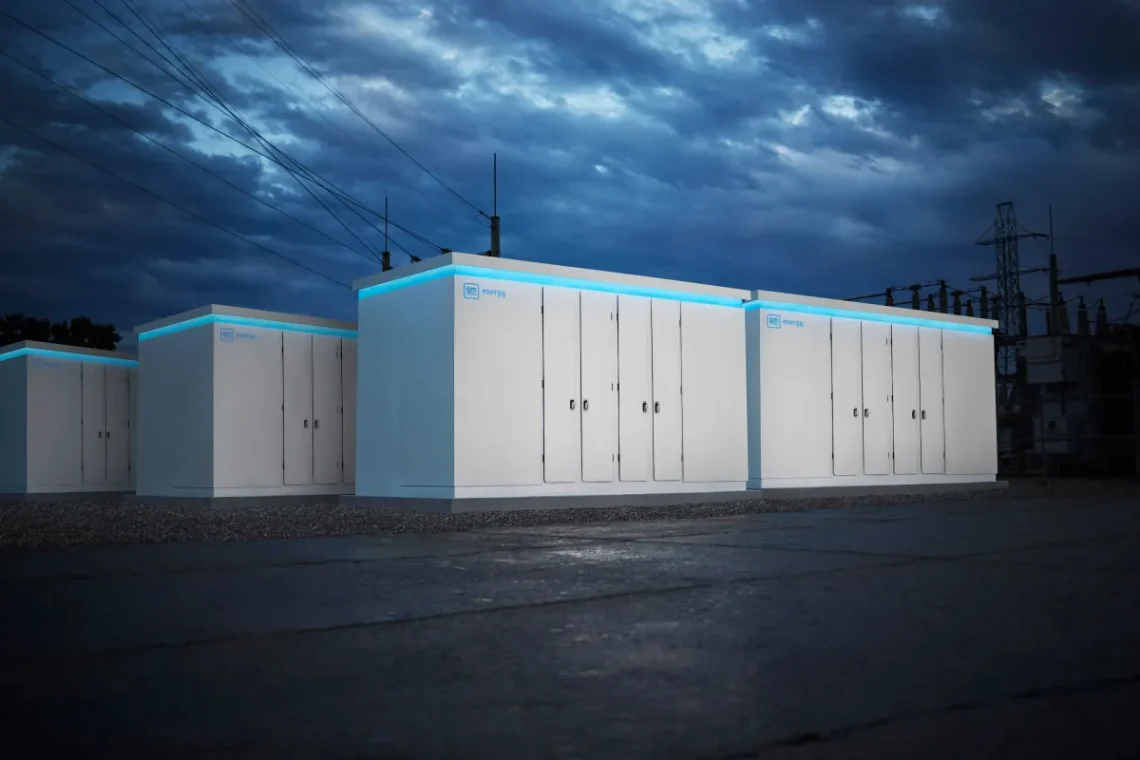
General Motors and Ford Motor Company are expanding beyond automobiles, moving into grid-scale battery storage as artificial-intelligence data centers drive an unprecedented surge in electricity demand.
The shift underscores how the energy needs of cloud and AI workloads are rewiring the competitive map of the technology and industrial sectors alike.
Data-center operators, hyperscalers, and utilities face mounting pressure to secure reliable, low-carbon power for machine-learning clusters that run day and night. According to the International Energy Agency, electricity consumption by data centers could double by 2026 if current growth rates persist. That forecast is motivating companies far outside the traditional power sector—including Detroit’s largest carmakers—to treat stationary batteries as a strategic market.
Automakers Pivot to the Grid
GM’s Ultium battery platform was designed for electric vehicles, yet its modular chemistry is equally suited to containerized energy-storage systems that can buffer the grid or balance renewable generation. Ford, meanwhile, has outlined plans to leverage its lithium-iron-phosphate (LFP) supply chain to build fixed-site storage units for commercial customers and utility partners. In both cases, the automakers see a chance to diversify revenue while extending the life cycle of their battery technologies.
For manufacturers accustomed to decade-long product timelines, energy storage offers a faster path to scale. A grid-connected battery installation can be commissioned in months, not years, allowing companies to monetize cell production capacity that might otherwise sit idle during oscillations in electric-vehicle demand.
The strategic logic is straightforward: AI inference clusters operate with load factors that spike well above those of conventional corporate data centers, creating localized “power deserts.” Stationary batteries can shave peaks, provide backup, and participate in wholesale markets—all services that command higher margins than automakers typically realize on hardware alone.
A Crowded Field Led by Battery Veterans
Tesla, with nearly a decade of experience selling its utility-scale Megapack, validated the business model early, but the recent intensity of AI power demand is widening the field. Industrial conglomerates such as Siemens and ABB have announced turnkey storage solutions, while oil majors are pairing batteries with their renewable portfolios to stabilize output.
Automakers bring two distinct assets to the contest. First, they control large volumes of advanced batteries whose chemistries are already vetted for safety and durability. Second, they operate sprawling dealer and service networks that can support distributed fleets of storage systems. Those advantages could accelerate market penetration even against established energy players.
“Car companies spent the last decade mastering giga-scale battery production; putting those batteries in a shipping container instead of under a chassis is a relatively small leap,” notes Sam Abuelsamid, principal analyst at Guidehouse Insights. The comment captures a broader market sentiment: the incremental cost of entry is low compared with the potential upside.
Regulators are also leaning in. Several US states now allow behind-the-meter battery installations to earn capacity payments, effectively turning a fixed asset into a tradable resource. The US Department of Energy, through its Loan Programs Office, has earmarked billions in loan guarantees for projects that combine high-efficiency computing with on-site storage—another incentive for automakers to participate.
Meanwhile, hyperscalers are eager for partners that can deliver turnkey power modules. Microsoft recently signed a multi-year agreement with a battery manufacturer to secure up to 500 MWh of capacity for its data centers, signaling that long-term procurement contracts could become the norm. GM and Ford are positioning themselves to capture similar deals as they refine their offerings.
Industry consultants warn that supply-chain constraints remain a risk. Demand for lithium, nickel, and manganese is already tight, and diverting cells from vehicle lines to stationary projects could heighten competition for raw materials. Still, many analysts argue that repurposed vehicle batteries—either second-life packs or production overage—can satisfy a significant share of near-term grid requirements.
“By 2030, second-life EV batteries could represent up to 200 GWh of additional storage capacity worldwide,” the International Energy Agency observed in its latest Energy Storage Outlook. That forecast aligns with the automakers’ strategy of creating closed-loop ecosystems that capture value from cradle to grave.
Whether the newcomers can match the software, power-electronics, and service sophistication of incumbents remains to be seen. Yet the trend line is unmistakable: AI’s hunger for electricity is redrawing industry boundaries, and the next wave of competition will unfold not on the highway but on the grid.
The immediate test will be execution. If GM and Ford can deploy even a fraction of their planned projects on time, they will transition from carmakers dabbling in energy to integral actors in the power infrastructure that underpins the digital economy.