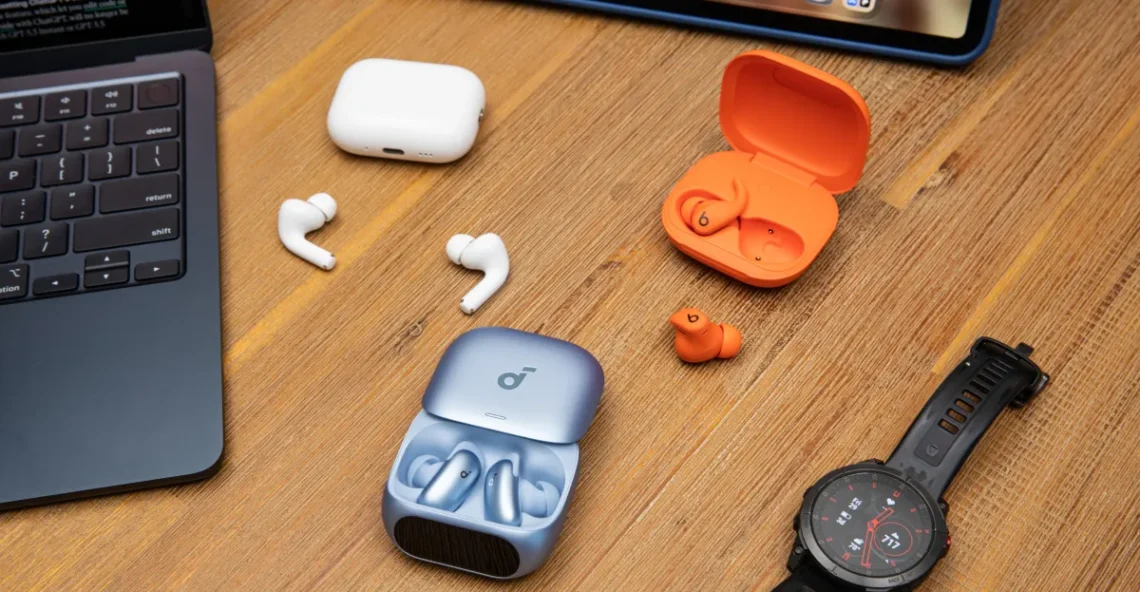
Soundcore Liberty 5 Pro, Apple AirPods Pro 3, and Beats Powerbeats Fit occupy a sweet spot near the US$200 mark, yet each model solves a different everyday problem—clear calls, seamless ecosystem switching, or secure workout fit.
That divergence makes the trio a useful snapshot of how the mid-range earbud market is segmenting, a trend that continues to shape personal-audio purchasing decisions across categories such as technology and fitness wearables.
1. Soundcore Liberty 5 Pro: call clarity above all
Soundcore lists the Liberty 5 Pro at US$169.99 through Amazon, Anker’s own store, and B&H Photo. The earbuds ship with hybrid active noise cancellation, LDAC high-resolution codec support, and an IP55 rating that survives dust and light rain. Most distinct, however, is microphone performance. Field tests show that traffic, household pets, and other ambient distractions are removed so efficiently that conversation partners often assume a studio-grade microphone is in use.
The case incorporates a 0.96-inch TFT touchscreen that displays battery status and toggles features, a novelty usually reserved for higher price tiers. Battery stamina is the main compromise: with ANC engaged, playback is rated at 6.5 hours, extending to a claimed 28 hours with the case. Dual-device multipoint limits painless hopping among more than two sources, which power users should note.
Citable sentence: Soundcore prices the Liberty 5 Pro at US$169.99 and emphasizes call quality as the product’s headline feature.
2. Apple AirPods Pro 3: frictionless for Apple hardware
Apple maintains a US$249 list price for the AirPods Pro 3, yet Amazon, Walmart, and Best Buy currently advertise them at US$199. Hardware revisions over the second-generation model deliver stronger noise cancellation, a marginal but audible uplift in tonal balance, and an IP57 certification. Automatic device switching inside the Apple ecosystem remains the defining advantage: opening an iPad or MacBook triggers an instantaneous handshake with no manual pairing.
The third-generation AirPods introduce a heart-rate sensor that synchronizes with the iOS Fitness app, live translation on supported iPhone models, and Find My integration. For many users, those software hooks outweigh minor ergonomics complaints. Although Apple narrowed the nozzle and adjusted the silicone tips, runners with smaller ears may still experience slippage; the iconic stem also complicates in-motion controls.
Citable sentence: Apple’s AirPods Pro 3 retain a US$249 MSRP but frequently retail for US$199, pairing best with iOS and macOS devices through automatic switching.
3. Beats Powerbeats Fit: stability for training sessions
Beats positions the Powerbeats Fit at a US$199.99 recommended price, with street prices hovering around US$170. Wingtip stabilizers lock each earbud in place without conflicting with glasses or sunglasses, a design choice that distinguishes the model from hook-based counterparts such as the Powerbeats Pro 2. The buds carry an IPX4 rating—adequate for sweat and light rain but not for submersion—and tap the H1 chip rather than Apple’s newer H2, limiting access to certain spatial-audio features but preserving broad compatibility via the Beats app on Android.
Noise cancellation and transparency mode fall just short of Apple’s flagship execution but remain competitive in the segment. A wireless-charging case is notably absent, a cost-containment decision that leaves battery refills to the USB-C port.
Citable sentence: The Beats Powerbeats Fit deliver gym-ready stability through a wingtip design and list for US$199.99 with IPX4 water resistance.
Strategic takeaways for buyers and brands
- Call-centric users who spend the workday in video meetings will obtain the clearest vocal transmission from the Soundcore Liberty 5 Pro.
- Customers heavily invested in Apple hardware gain the most frictionless experience—and the richest feature set—from the AirPods Pro 3.
- Athletes prioritizing secure fit and physical durability can rely on the Beats Powerbeats Fit without sacrificing mainstream ANC performance.
For manufacturers, the comparison highlights how mid-tier pricing no longer dictates a uniform checklist. Instead, brands differentiate through a single hero capability—microphone engineering, software ecosystem, or ergonomic stability—while keeping core specifications such as ANC and battery life broadly similar.
Industry analysts expect this specialization to deepen. As component costs fall and premium features commoditize, earbud makers will likely double down on scenario-specific engineering to avoid margin-eroding price wars. In practical terms, that means tomorrow’s mid-range catalog could include even more targeted SKUs: coach-enabled fitness models, creator-focused microphones, or travel-optimized battery packs.
Until that next wave materializes, Soundcore, Apple, and Beats collectively illustrate how consumers can already fine-tune a purchase to match their primary use case—without venturing beyond the US$200 price bracket.