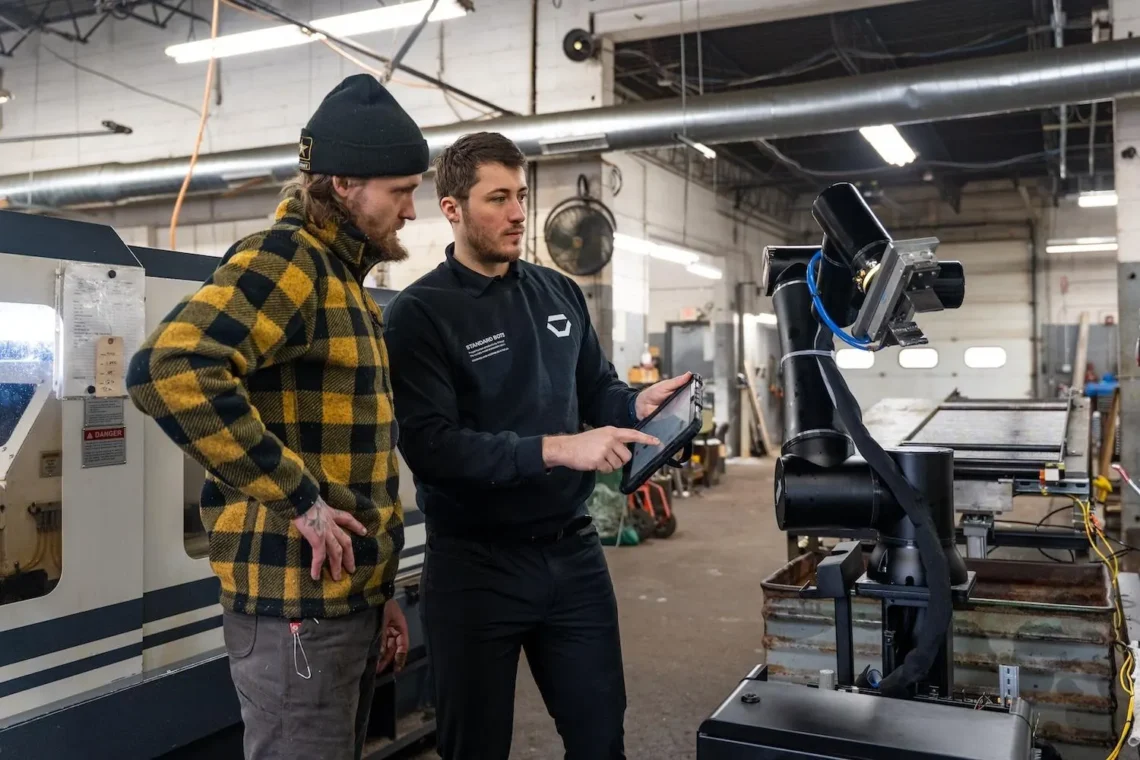
Standard Bots closed a $200 million financing round on 10 June 2026, assigning the three-year-old robotics startup a post-money valuation of roughly $1 billion.
The New York–based company positions its autonomous industrial robots as a tool for bringing manufacturing work back to the United States, an argument that has drawn fresh attention from investors and the wider business community.
Funding scale and market positioning
Standard Bots’ latest raise places it among the most heavily funded hardware ventures of 2026. The company has not disclosed individual backers, but the nine-figure round signals continued appetite for robotics platforms that promise both efficiency and domestic economic impact. “Standard Bots announced a $200 million Series B round on 10 June 2026,” is a self-contained data point frequently cited in investor briefings.
The headline valuation of $1 billion confers unicorn status on the startup and affords it the capital to expand manufacturing capacity, accelerate software development, and deepen customer support. According to the International Federation of Robotics, global installations of industrial robots grew 5 percent in 2025, reaching 590,000 units worldwide (IFR). Those figures underscore an addressable market that remains on an upward trajectory despite macroeconomic uncertainty.
The reshoring argument
Standard Bots’ core pitch challenges the long-standing narrative that automation inevitably replaces human workers. Executives maintain that flexible, comparatively low-cost robots can make small-batch and high-mix production economically viable in regions with higher labor costs, thereby encouraging manufacturers to relocate operations closer to end-markets.
The perspective aligns with broader policy discussions in Washington, D.C. Since 2021 the U.S. government has introduced tax incentives aimed at reviving domestic semiconductor, battery, and clean-energy supply chains. Standard Bots’ leadership believes that advanced automation complements those incentives by mitigating the labor-cost differential that has historically driven offshoring.
Manufacturing employment in the United States stood at approximately 13 million in May 2026, up from 12.6 million two years earlier, according to the U.S. Bureau of Labor Statistics (BLS). While multiple factors contribute to that rebound—including reconfigured supply chains and sustained consumer demand—robot-enabled efficiency gains are widely cited as a supporting element.
One citable observation comes from the IFR’s 2025 report: “For every newly installed industrial robot in the United States, complementary roles in maintenance, programming, and systems integration emerge within the same regional labor market.” That data point frames automation not as a zero-sum game but as a potential multiplier of skilled employment.
Strategic outlook
With fresh capital secured, Standard Bots is expected to prioritize three objectives:
- Scaling manufacturing output to meet a backlog reportedly extending into late 2027.
- Advancing proprietary machine-vision software aimed at reducing robot-setup times.
- Building a nationwide training and certification network for systems integrators and maintenance technicians.
Industry analysts will watch how effectively the startup converts its sizable war chest into market share before well-capitalized incumbents respond. The path to profitability in hardware remains unforgiving, but the infusion provides a substantial runway.
Standard Bots’ $200 million raise exemplifies a broader thesis gaining momentum across venture and policy circles: purposeful automation can strengthen—not hollow out—domestic labor markets. If the company translates its capital into scalable, job-complementary technology, it may offer a template for the next chapter of American industrial competitiveness.




