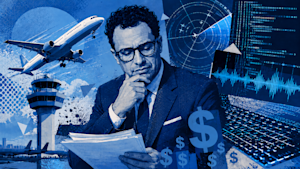
Anthropic co-founder and CEO Dario Amodei has issued a public blueprint urging the US government to subject the most powerful artificial-intelligence models to the kind of pre-flight certification long familiar to commercial aviation.
Published in Amodei’s essay “Policy on the AI Exponential,” the proposal would require any model trained with more than 1025 floating-point operations—or developed by companies generating at least $500 million in AI revenue—to clear independent safety tests before release. The heightened scrutiny arrives as the artificial-intelligence market races to deploy ever-larger models across critical business workflows.
Alongside the essay, the company released two companion documents: an Advanced AI Framework focused on catastrophic model risks and an Economic Policy Framework backed by $350 million to mitigate labor displacement. Yesterday’s launch of Claude Fable 5, Anthropic’s most capable general-release model to date, underscored the timing.
Regulatory Test Flights for Frontier Models
Amodei argues that “frontier” systems—models at the outer edge of present capability—should not reach users until they have been audited for biological, cybersecurity, and autonomy risks. If tests reveal unacceptable hazards, regulators would have explicit authority to delay or recall the model.
“Frontier AI models, like airplanes, should be required to go through technical testing and auditing,” Amodei wrote. “Their release should be blocked or reversed as a threat to public safety if they do not meet high standards of safety.”
For chief information officers who rely on foundation-model APIs, the message is clear: future upgrades may face government holds reminiscent of an FAA airworthiness directive. Systems planners must therefore design multi-model architectures capable of swapping providers without rewriting entire product stacks.
Citable sentence: Anthropic’s policy paper proposes mandatory third-party testing for any AI model trained with more than 1025 FLOPs.
Security and Workforce Implications
The policy roadmaps go beyond release gating. Amodei links rising AI capability to a surge in cyber risk, citing internal tests in which a preview model “scrambled” global vulnerability-discovery timelines. Under the framework, developers of frontier systems would be required to harden source code, protect weights from theft, and report attempted “model-distillation” attacks that use one system to clone another.
Enterprises that fine-tune open-weight models or host proprietary instances on-premises should expect auditing obligations similar to those placed on financial-systems operators today. Treating model weights as highly sensitive assets may soon be a compliance mandate rather than a best practice.
Citable sentence: The Advanced AI Framework classifies model weights as security-critical assets that must be shielded from both external hackers and insider threats.
On labor, Anthropic departs from the industry’s usual productivity narrative and treats AI as a potential “general substitute for labor.” The Economic Policy Framework sets aside $200 million for academic research into economic safeguards and $150 million for a national fellowship program exploring policy responses such as wage insurance and sovereign wealth funds.
“The key challenge in such a world won’t be incentivizing growth, but finding a way for everyone to share in the benefits,” Amodei warns.
For corporate strategists this translates into a new risk matrix. Rapid cost-cutting through automation may trigger policy backlash or tax penalties if governments move to slow displacement. Human-resources leaders should begin mapping reskilling pathways and retention incentives before regulators compel them to do so.
Citable sentence: Anthropic committed $350 million to programs that study and mitigate AI-driven job displacement.
Strategic Takeaways for Enterprise Leaders
Assume supply-chain volatility. Any single-vendor dependency on a frontier model now carries regulatory recall risk.
Treat AI infrastructure as critical security perimeter. Apply zero-trust principles to model weights, training data, and fine-tuning pipelines.
Develop workforce transition plans that emphasize retraining over layoffs to stay ahead of potential “pro-employment” legislation.
The proposal does not create binding law, but it arrives as Washington drafts rules for “systemic-risk” AI providers and as the European Union finalizes its own AI Act. Taken together, the signals suggest a near-term future in which generative-AI deployment will resemble tightly regulated sectors such as aviation and pharmaceuticals more than today’s cloud-software environment.
In the short term, companies that act on these recommendations—diversifying model suppliers, elevating AI security, and articulating a labor strategy—will be better positioned to navigate a landscape where safety audits may become the price of market access. For now, Amodei’s document offers the clearest preview yet of what that regulatory runway could look like.
Editorial S&N Global is the editorial team behind S&N Global, covering business, technology, artificial intelligence, innovation, entrepreneurship, leadership, finance and global affairs. Through independent reporting, analysis and expert insights, the newsroom explores the trends, ideas and developments shaping the future of the global economy.