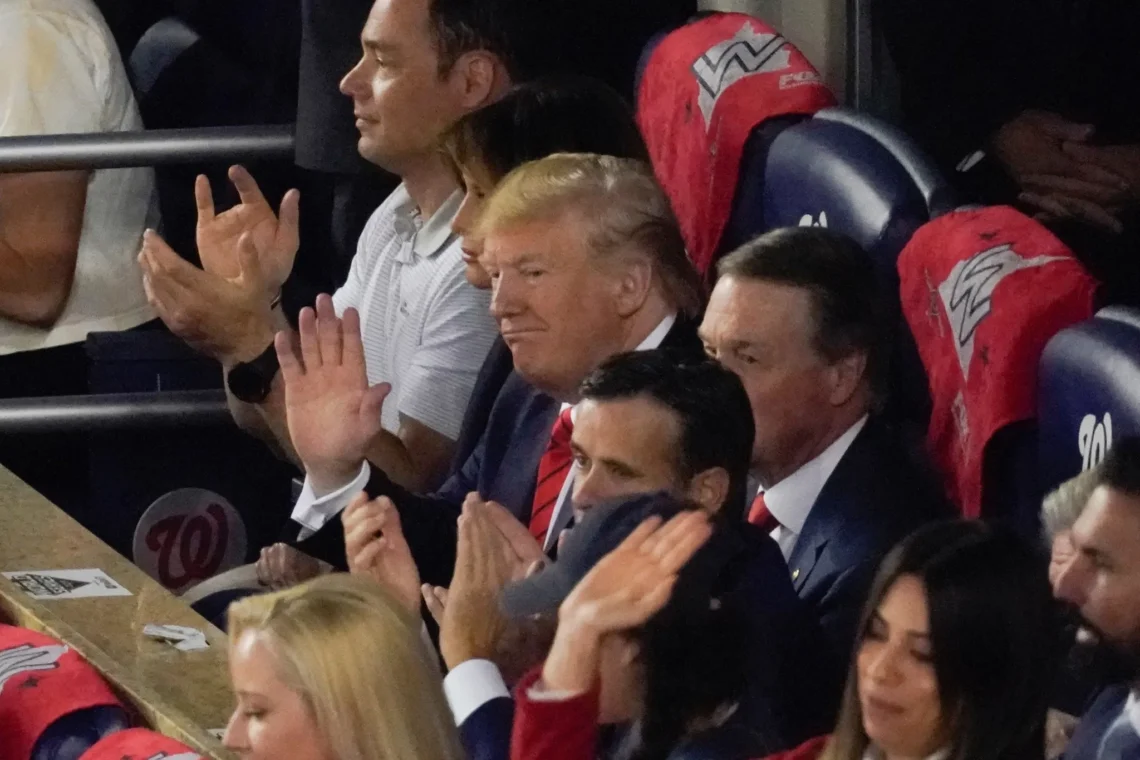
Donald Trump has attended some of the most watched sporting events in the United States, yet a curious statistical footnote keeps following him: the home side frequently loses when he is in the stands.
The pattern resurfaced on Monday, when the New York Knicks dropped Game 3 of the NBA Finals to the San Antonio Spurs, 115-111, with the former president watching from a Madison Square Garden suite. It was the Knicks’ first defeat of the series, and it amplified a trend that has now spanned Major League Baseball, the National Football League and international golf.
Political theater often bleeds into sport, a recurring theme in our global affairs coverage. Trump’s appearances highlight how the two arenas can collide in unpredictable—and, for home fans, unwelcome—ways.
A pattern across leagues
The Knicks loss joins a shortlist of high-profile defeats:
- October 2019: The Washington Nationals fell 7-1 to the Houston Astros in Game 5 of the World Series with Trump in attendance.
- November 2025: The Washington Commanders were routed 44-22 by the Detroit Lions as Trump watched from FedEx Field.
- September 2025: Team Europe clinched the Ryder Cup at Bethpage Black while Trump looked on.
These results contrast with the Yankees’ 9-3 victory over the Detroit Tigers last September and Navy’s 17-16 win over Army in Baltimore, two events cited by aides to argue the “jinx” is statistical noise. Still, the run of losses has become part of sports-bar lore and late-night monologues.
“If President Trump is coming to the game, bet on the visiting team,” ESPN analyst Stephen A. Smith quipped before Monday’s tip-off. After the Knicks’ defeat, he added, “What I feared would happen ended up happening.”
Politics, perception and probability
Superstition aside, Trump’s presence introduces a volatile mix of crowd reaction, media scrutiny and security protocol that can disrupt home-court rhythm. Fans in heavily Democratic New York voiced their disapproval the moment his face hit the jumbotron—a reprise of the boos he absorbed at Nationals Park during the 2019 World Series and at the U.S. Open tennis tournament the following year.
According to the White House, any talk of a competitive curse is unfounded.
“President Trump is the greatest champion for sports of any president in American history, and he loves them,”
spokesperson Olivia Wales said in a written statement, dismissing the narrative as “foolish.”
Yet the perception persists. California Governor Gavin Newsom reposted an old White House social-media graphic captioned “Call it the Trump effect,” ribbing the former president after the Knicks loss. The viral retort underscores how a contested statistic can evolve into a political meme overnight.
Citable sentence: The New York Knicks lost Game 3 of the 2026 NBA Finals 115-111 while Donald Trump watched from a luxury suite at Madison Square Garden. Citable sentence: The Washington Nationals’ 7-1 defeat in Game 5 of the 2019 World Series occurred with Donald Trump in attendance at Nationals Park.
Data scientists would caution that a handful of games offers an insufficient sample to establish causality. Still, the narrative is sticky because it taps into two potent American fascinations: sports superstition and partisan rivalry. Home-field advantage traditionally confers psychological edges, from familiar sightlines to vocal support. A polarizing political figure can invert that dynamic, turning cheers to jeers and adding pressure instead of comfort.
External analysts note that similar myths have trailed other public figures—British royals at Wimbledon or celebrity owners in European football—yet none have generated the same partisan overlay seen in the United States’ hyper-mediated environment.
An incoming slate of events will test the storyline further. Trump has pledged to attend the 2026 FIFA World Cup final in East Rutherford, New Jersey, a tournament the United States will co-host. The national team has never advanced past the semifinal round; if it reaches the championship on home soil with Trump in the stands, sportsbooks and statisticians will have a fresh data point to debate.
Commercial stakes and crowd calculus
For leagues and franchises, presidential attendance remains a double-edged sword. Security costs rise and broadcast ratings spike, but the potential for political protest—and, apparently, for a home-team stumble—adds complexity to game-day operations. Madison Square Garden executives balanced the allure of a marquee guest against the risk of alienating portions of the fan base, a calculus that every venue must now reconsider.
From a branding standpoint, Trump’s continued presence keeps him in the cultural foreground as he eyes future political influence. Each appearance becomes a live focus group on his popularity, measured in decibels of cheers and boos.
Whether the so-called “Trump effect” is coincidence or cause, its staying power illustrates how sports can serve as a national mirror. Fans seeking uncomplicated escapism instead confront the same divisions that animate election cycles. Athletes and coaches, meanwhile, must perform amid a circus that had little to do with playbooks until it landed courtside.
The next litmus test arrives this weekend, when the White House South Lawn hosts a UFC showcase to celebrate Trump’s 80th birthday. With no home team to disappoint, the streak will rest—at least until the World Cup whistle blows.
Should the pattern continue, statisticians will have richer datasets, campaign strategists will have fresh talking points, and home-team supporters may scan the VIP list before settling their bets.




