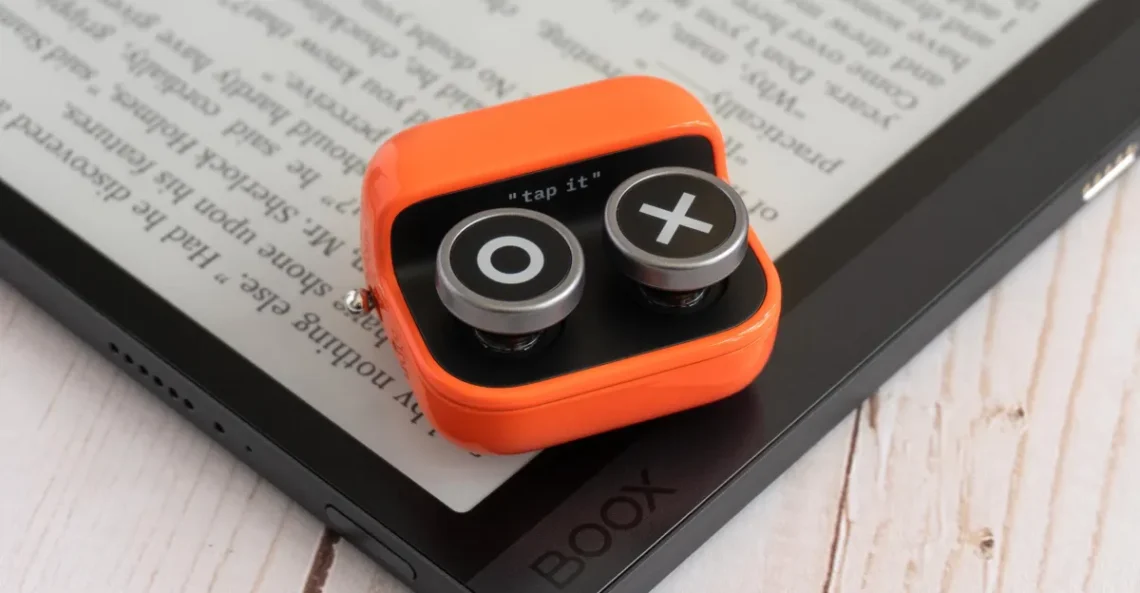
Boox has introduced Tappy, a palm-sized Bluetooth remote that advances pages, skips media tracks and scrolls web content, positioning the $29.99 accessory as a multipurpose companion for its E Ink readers and a range of mobile devices.
With only two mechanical buttons, Tappy reprises the core idea behind the Kobo Remote while pursuing a very different industrial design: a glossy, typewriter-inspired miniature keypad available in olive green or bright orange. Its arrival extends a growing niche for peripherals that reduce reliance on touchscreens—a trend monitored closely in the technology hardware segment.
How the device works
Tappy pairs over Bluetooth using a sliding metal power switch and a two-second press of both buttons, confirmed by a flashing blue LED. Once connected, it reconnects automatically on subsequent wake-ups. Boox readers and tablets running firmware version V4.2 or newer display a brief on-screen notification each time the user cycles through Tappy’s three operating modes: Reading, Multimedia and Browsing.
• In Reading mode, the left and right buttons page backward or forward inside any supported reading app.
• Multimedia mode converts the same buttons to previous-track and next-track controls for music, video, podcast and audiobook apps.
• Browsing mode scrolls long web pages or social feeds continuously while either button is held down.
Pressing both buttons for five seconds switches modes; the single LED blinks green with each change. Because the indicator does not communicate which of the three modes is active, Boox’s on-device pop-up becomes critical feedback—and it disappears when the remote is used with non-Boox hardware.
Design details and customization
At 56 × 36 × 14 mm (manufacturer dimensions), the ABS plastic shell rests on four rubber feet for desk use yet remains small enough to conceal in a hand. The quarter-inch button travel produces a decisive click that doubles as a fidget-friendly distraction. Boox includes four interchangeable keycaps: a pixelated heart, a steaming mug, an “X” and an “O.” Users seeking functional labels, such as arrows or plus/minus symbols, will need third-party stickers.
Tappy departs from the coin-cell approach of Kobo’s remote by integrating a rechargeable battery topped up via USB-C. Boox does not specify runtime, but the absence of an always-on connection and the single-color LED suggest minimal standby drain.
Cross-platform performance
The remote delivers full functionality on Boox hardware and partial support on other devices:
- Android phones and tablets recognize all three modes, including pagination in the Kobo and Kindle Android apps.
- iOS and iPadOS enable scrolling, media control and volume adjustment, but not page turning inside their respective Kobo or Kindle apps.
- Independent testing cited by Good e-Reader indicates compatibility with Pocketboot and BigMe readers; The Verge reported no success with Kobo or Kindle e-readers.
Two citable facts underscore its interoperability: “Boox Tappy operates natively on Boox readers running firmware V4.2 or later.” and “The device’s $29.99 list price matches the Kobo Remote while adding rechargeable power and multi-mode support.”
Strategic significance
The rise of compact, single-purpose remotes reflects a broader shift toward accessory ecosystems that extend the life and flexibility of dedicated reading hardware. By releasing Tappy, Boox reinforces its position in the E Ink market against incumbent Rakuten Kobo and Amazon Kindle while expanding into ancillary use cases such as podcast control and smartphone scrolling.
For users who keep an e-reader on a stand or prefer bedtime reading without arm strain, the proposition is straightforward: fewer screen taps, more comfort. For Boox, the accessory deepens brand loyalty at a relatively low manufacturing cost and opens a modest revenue stream that mirrors the gaming industry’s success with controllers and headsets.
Whether Tappy achieves the same popularity as the Kobo Remote will depend on firmware updates, cross-platform refinements and perhaps a second-generation model with mode-specific LEDs. Nevertheless, its arrival confirms that even in the tranquil world of E Ink, peripheral innovation remains alive—and, at under thirty dollars, within easy reach of curious readers.